

Introduction
Alexander Graham Bell Biography tells the inspiring story of one of history’s greatest inventors, educators, and scientists. Best known as the inventor of the telephone, Bell transformed the way people communicate and laid the foundation for the modern telecommunications industry. His groundbreaking innovations changed everyday life, making long-distance communication faster and more accessible than ever before.
Born on March 3, 1847, in Edinburgh, Scotland, Alexander Graham Bell developed a passion for sound, speech, and education from an early age. Influenced by his family’s work with speech and hearing, he dedicated much of his life to helping people with hearing impairments while pursuing scientific research. His curiosity and determination eventually led to one of the most important inventions in human history—the telephone.
In this comprehensive Alexander Graham Bell Biography, you’ll discover his early life, family background, education, remarkable career, and the events that inspired his revolutionary inventions. We’ll also explore his major achievements, scientific contributions, personal life, philanthropy, business ventures, and lasting legacy. Whether you’re a student, history enthusiast, or simply curious about the man who forever changed global communication, this guide provides everything you need to know about Alexander Graham Bell and the extraordinary impact he had on the modern world.
Read Also: Jude Law Biography: Early Life, Career, Family & Net Worth
Quick Facts
| Fact | Details |
|---|---|
| Full Name | Alexander Graham Bell |
| Known As | Alexander Graham Bell |
| Date of Birth | March 3, 1847 |
| Date of Death | August 2, 1922 |
| Age at Death | 75 years |
| Birthplace | Edinburgh, Scotland |
| Nationality | Scottish-born (later naturalized Canadian and worked extensively in the United States) |
| Profession | Inventor, Scientist, Engineer, Educator |
| Famous For | Inventing the Telephone |
| Height | Not publicly documented |
| Weight | Not publicly documented |
| Father | Alexander Melville Bell |
| Mother | Eliza Grace Symonds Bell |
| Spouse | Mabel Gardiner Hubbard (m. 1877–1922) |
| Children | Elsie May Bell, Marian “Daisy” Bell (two sons died in infancy) |
| Education | University of Edinburgh (attended), University College London (attended); no formal degree completed |
| Residence | Canada and the United States (primarily Nova Scotia and Washington, D.C.) |
| Known For | Telephone, Photophone, Metal Detector, Audiometer |
| Estimated Net Worth | Not publicly documented; no reliable historical estimate available |
| Legacy | Widely regarded as one of the greatest inventors in history and a pioneer of modern telecommunications |
Early Life
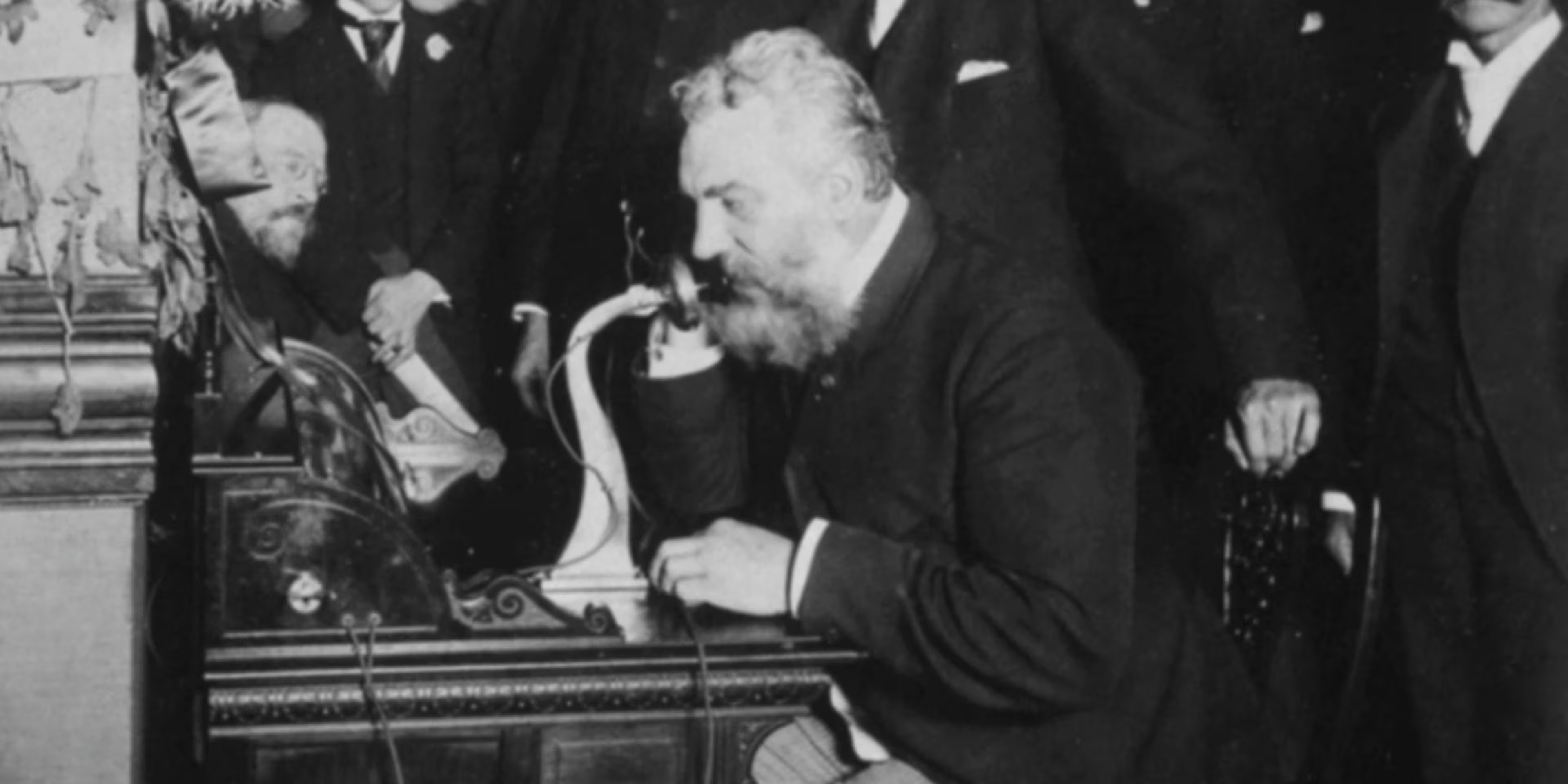
Alexander Graham Bell was born on March 3, 1847, in Edinburgh, Scotland, into a family deeply connected to the study of speech, language, and communication. His early years were shaped by an intellectually stimulating environment, where education, science, and language played central roles. This upbringing inspired his lifelong curiosity about sound and ultimately led to inventions that transformed global communication.
Childhood in Edinburgh
Bell spent his childhood in Edinburgh, where he showed exceptional intelligence and curiosity from an early age. Unlike many children of his time, he enjoyed experimenting with mechanical devices and solving practical problems. He was fascinated by how sound traveled and how people produced speech, interests that would later define his scientific career.
Although he was a bright student, Bell preferred hands-on learning and independent exploration over traditional classroom education. He often conducted small experiments at home and developed a passion for invention while still a young boy.
A Family of Speech Experts
Alexander Graham Bell grew up in a remarkable family dedicated to the science of speech.
- His father, Alexander Melville Bell, was a respected professor and speech specialist who developed the Visible Speech system, a method designed to help teach pronunciation and assist people with speech difficulties.
- His grandfather, Alexander Bell, was also a renowned teacher of elocution.
- His mother, Eliza Grace Symonds Bell, was an accomplished pianist who gradually lost her hearing. Despite her hearing impairment, she remained an important influence on Bell’s life.
His mother’s deafness had a profound impact on him. As a young boy, he learned to communicate with her by speaking clearly, using gestures, and positioning himself so she could better understand him. These experiences sparked his lifelong interest in helping people with hearing impairments.
Early Education
Bell attended several schools in Scotland, including the Royal High School of Edinburgh, although he was not particularly enthusiastic about formal education. He later continued his studies privately and attended the University of Edinburgh and University College London, where he expanded his knowledge of science, anatomy, acoustics, and speech.
While he never completed a formal university degree, his education combined classroom learning with practical experimentation, laying the foundation for his future inventions.
Move to Canada
During the late 1860s, Bell’s family experienced personal tragedy when his two brothers died from tuberculosis. Concerned about Alexander’s health, the Bell family emigrated to Brantford, Ontario, Canada, in 1870.
The peaceful countryside of Brantford provided Bell with the freedom to conduct scientific experiments and continue exploring ideas related to sound transmission and electricity. It was here that many of the concepts leading to the invention of the telephone first began to take shape.
Passion for Science
From childhood onward, Bell displayed an extraordinary curiosity about science and engineering. He enjoyed reading scientific literature, building mechanical devices, and experimenting with acoustics. His fascination with communication and hearing eventually guided him toward groundbreaking research that would change the world forever.
Early Life Highlights
| Aspect | Details |
|---|---|
| Birth Date | March 3, 1847 |
| Birthplace | Edinburgh, Scotland |
| Childhood Home | Edinburgh, Scotland |
| Parents | Alexander Melville Bell and Eliza Grace Symonds Bell |
| Early Interests | Sound, speech, science, mechanics, and invention |
| Education | Royal High School of Edinburgh, University of Edinburgh, University College London |
| Moved to Canada | 1870 (Brantford, Ontario) |
Alexander Graham Bell’s early life was shaped by a unique blend of family influence, intellectual curiosity, and personal experiences. Growing up in a household devoted to the study of speech and witnessing his mother’s hearing loss inspired his lifelong mission to improve communication. These formative years laid the groundwork for the inventions and scientific discoveries that would earn him a permanent place in history as one of the world’s greatest innovators.
Family Background
Alexander Graham Bell was born into a distinguished family of educators and speech specialists whose work profoundly influenced his life and career. His family’s dedication to language, communication, and education played a crucial role in shaping his interests, eventually leading to his groundbreaking inventions in telecommunications.
Parents
Father: Alexander Melville Bell
Alexander Graham Bell’s father, Alexander Melville Bell (1819–1905), was a renowned Scottish educator, speech therapist, and researcher. He became internationally recognized for developing Visible Speech, a phonetic system that used written symbols to represent the position of the tongue, lips, and throat during speech.
His work helped teachers instruct people with speech and hearing difficulties, and Bell often assisted his father in demonstrating the system. This early exposure to phonetics and communication greatly influenced Bell’s future scientific research.
Mother: Eliza Grace Symonds Bell
Bell’s mother, Eliza Grace Symonds Bell (1809–1897), was an intelligent and talented pianist. She gradually lost most of her hearing during Alexander’s childhood, an experience that deeply affected him.
To communicate with his mother, Bell learned to speak clearly, use facial expressions, and communicate through gestures. He also discovered ways to help her “hear” by speaking close to her forehead, allowing her to perceive vibrations. These experiences inspired his lifelong interest in acoustics, hearing, and communication.
Siblings
Alexander Graham Bell had two older brothers:
- Melville James Bell
- Edward Charles Bell
Both brothers died from tuberculosis during early adulthood. Their deaths had a profound emotional impact on the Bell family and influenced the decision to emigrate from Scotland to Canada in 1870, where they hoped the healthier climate would benefit Alexander’s health.
Family Influence
The Bell family was deeply committed to education and the science of speech.
Several generations worked as:
- Speech teachers
- Elocution experts
- Researchers in phonetics
- Educators
Growing up in this environment, Alexander Graham Bell was surrounded by discussions about language, pronunciation, hearing, and communication. This unique upbringing laid the foundation for his later scientific discoveries.
Marriage and Children
In 1877, Alexander Graham Bell married Mabel Gardiner Hubbard, who had lost her hearing as a child following an illness. Mabel became one of Bell’s strongest supporters and played an important role in encouraging his scientific work and business ventures.
Together, they had four children:
- Elsie May Bell (survived to adulthood)
- Marian Hubbard “Daisy” Bell (survived to adulthood)
- Edward Bell (died in infancy)
- Robert Bell (died in infancy)
A Supportive Family Environment
Bell’s family provided both emotional support and intellectual inspiration throughout his life. His father’s expertise in speech, his mother’s hearing impairment, and his wife’s encouragement all contributed to his passion for improving communication for people around the world.
Family Background Overview
| Family Member | Details |
|---|---|
| Father | Alexander Melville Bell – educator and inventor of Visible Speech |
| Mother | Eliza Grace Symonds Bell – pianist who became deaf later in life |
| Brothers | Melville James Bell and Edward Charles Bell |
| Spouse | Mabel Gardiner Hubbard (married in 1877) |
| Children | Elsie May Bell, Marian “Daisy” Bell, Edward Bell (died in infancy), Robert Bell (died in infancy) |
| Family Profession | Education, phonetics, speech science, and elocution |
Alexander Graham Bell’s family background played a defining role in his life and achievements. Raised in a household devoted to speech and education and inspired by the experiences of his mother and wife, both of whom were deaf or hard of hearing, Bell dedicated his career to advancing communication. His family’s influence helped shape the ideas that ultimately led to one of the most significant inventions in human history—the telephone.
Education
Alexander Graham Bell’s education combined formal schooling, university study, practical experience, and guidance from his family. Growing up in a household devoted to speech and language, Bell developed an early interest in science, acoustics, and communication that would later lead to some of history’s most influential inventions.
Early Schooling
Bell received his early education in Edinburgh, Scotland, where he attended the Royal High School of Edinburgh. Although he was an intelligent student, he was often more interested in science, music, mechanics, and experimentation than traditional classroom lessons.
His curiosity frequently extended beyond the school curriculum, and he preferred learning through observation and hands-on experiments.
Family Education
A significant part of Bell’s education came from his father, Alexander Melville Bell, one of the world’s leading experts in phonetics and speech education. Through his father’s work, Bell learned about:
- Speech production
- Human anatomy related to speech
- Phonetics
- Communication methods
- Teaching techniques for people with hearing impairments
This practical education became one of the strongest foundations for his future inventions.
University of Edinburgh
After leaving school, Bell attended the University of Edinburgh in Scotland. During his studies, he continued exploring subjects related to science, language, and communication while assisting his father with speech demonstrations.
Although he attended the university, he did not complete a formal degree program.
University College London
Following his time in Edinburgh, Bell also studied at University College London (UCL). His studies focused on:
- Anatomy
- Physiology
- Acoustics
- Speech science
- Natural sciences
Once again, Bell left before earning a university degree, choosing instead to pursue independent research and teaching opportunities.
Independent Learning
Much of Alexander Graham Bell’s knowledge came through self-directed learning and practical experimentation. Throughout his life, he:
- Read scientific journals extensively.
- Conducted experiments on sound and electricity.
- Worked closely with educators and scientists.
- Taught students with hearing impairments.
- Continued researching communication technologies.
His ability to combine scientific theory with practical experimentation became one of his greatest strengths.
Honorary Degrees and Recognition
Although Bell never completed a traditional university degree, his extraordinary scientific contributions earned him numerous honorary doctorates and academic honors from universities around the world. These recognitions acknowledged his lasting impact on science, engineering, medicine, and education.
Education Overview
| Institution | Details |
|---|---|
| Royal High School of Edinburgh | Early secondary education |
| University of Edinburgh | Attended; no degree completed |
| University College London (UCL) | Studied anatomy, physiology, and acoustics; no degree completed |
| Primary Fields of Study | Speech, phonetics, anatomy, acoustics, communication, natural sciences |
| Academic Degree | No formal university degree |
| Later Recognition | Received numerous honorary doctorates and academic awards |
Alexander Graham Bell’s educational journey demonstrates that innovation is driven by curiosity as much as by formal qualifications. While he never earned a university degree, his dedication to lifelong learning, scientific experimentation, and the study of speech and communication enabled him to revolutionize the world through the invention of the telephone and many other groundbreaking discoveries. His legacy continues to inspire students, researchers, and inventors across generations.
Career Journey
Alexander Graham Bell’s career is one of the most remarkable success stories in the history of science and technology. Beginning as a teacher of speech and hearing, he evolved into one of the world’s greatest inventors, forever transforming global communication with the invention of the telephone. His professional journey combined education, scientific research, engineering, and entrepreneurship, leaving a legacy that continues to shape modern society.
Early Career as a Teacher
Bell began his career by teaching speech and elocution, following in the footsteps of his father and grandfather, who were respected experts in phonetics and speech education. After moving to Canada in 1870 and later to Boston, Massachusetts, he taught at several schools for deaf students.
His passion for helping people with hearing impairments led him to become a respected instructor at institutions including:
- Boston School for Deaf Mutes
- Clarke School for the Deaf
- Boston University School of Oratory
During this period, Bell conducted extensive research into sound, speech, and acoustics while teaching students with hearing disabilities.
Research into Sound and Electricity
While working as a teacher, Bell became fascinated by the possibility of transmitting multiple telegraph messages simultaneously over a single wire. His experiments on the harmonic telegraph gradually expanded into research on transmitting the human voice electrically.
Working closely with skilled machinist Thomas A. Watson, Bell spent countless hours designing and testing new communication devices.
Breakthrough: Inventing the Telephone
Bell’s defining career breakthrough came on March 10, 1876, when he successfully transmitted the first intelligible telephone message to Thomas Watson.
His famous words—
“Mr. Watson, come here, I want to see you.”
—marked the beginning of a new era in human communication.
Just days earlier, Bell had received U.S. Patent No. 174,465 for the telephone, securing one of the most valuable patents in history.
The invention revolutionized communication by allowing people to speak across long distances, laying the foundation for today’s global telecommunications networks.
Establishing the Bell Telephone Company
Following the success of the telephone, Bell helped establish the Bell Telephone Company in 1877. The company rapidly expanded telephone services throughout North America and later became one of the foundations of the modern telecommunications industry.
Although Bell gradually stepped away from the day-to-day management of the business, the company’s success provided financial resources that allowed him to continue scientific research.
Expanding Scientific Research
Bell never limited himself to the telephone. Throughout his career, he pursued research in numerous scientific fields, including:
- Acoustics
- Aviation
- Electrical engineering
- Medical technology
- Optical communication
- Marine engineering
Among his most notable inventions and innovations were:
- Photophone, which transmitted sound using light beams.
- Metal detector, developed in an attempt to locate a bullet inside U.S. President James A. Garfield.
- Audiometer, designed to measure hearing ability.
- Improvements to early graphophone recording technology.
Aviation and Hydrofoil Experiments
Later in life, Bell became deeply interested in flight and marine engineering. He co-founded the Aerial Experiment Association (AEA) in 1907, supporting the development of early powered aircraft.
He also worked on hydrofoil boats, helping design vessels capable of reaching record-breaking speeds across water.
These projects demonstrated his ability to innovate across multiple scientific disciplines.
Leadership and Scientific Recognition
Bell served as the second president of the National Geographic Society from 1898 to 1903. During his leadership, he encouraged the publication of high-quality photographs and scientific articles, helping transform the magazine into one of the world’s most respected educational publications.
His scientific achievements earned numerous honorary degrees, medals, and awards from universities and institutions worldwide.
Lasting Legacy
Although Alexander Graham Bell passed away on August 2, 1922, his work continues to influence modern technology. The telephone evolved into mobile phones, smartphones, and global communication networks, while his research in acoustics, education, and engineering continues to inspire scientists and inventors.
Today, Bell is remembered not only as the inventor of the telephone but also as a visionary whose innovations changed how people communicate, learn, and connect across the world.
Career Highlights
| Year | Milestone |
|---|---|
| 1870 | Moved to Canada and began teaching speech |
| 1871 | Started teaching deaf students in Boston |
| 1874 | Began research leading to the invention of the telephone |
| 1876 | Invented and patented the telephone |
| 1877 | Co-founded the Bell Telephone Company |
| 1880 | Invented the Photophone |
| 1881 | Developed an early metal detector |
| 1898–1903 | Served as President of the National Geographic Society |
| 1907 | Co-founded the Aerial Experiment Association |
| Early 1900s | Conducted pioneering hydrofoil research |
Alexander Graham Bell’s career reflects a lifelong commitment to innovation, education, and scientific discovery. From teaching students with hearing impairments to revolutionizing global communication through the invention of the telephone, his achievements reshaped the modern world. His pioneering work in telecommunications, aviation, acoustics, and engineering continues to influence technology and inspire generations of inventors and researchers.
Major Achievements
Alexander Graham Bell is widely regarded as one of the greatest inventors in history. His groundbreaking work in communication, education, and scientific research transformed the modern world. Beyond inventing the telephone, Bell made important contributions to acoustics, aviation, optical communication, and education for people with hearing impairments.
1. Invented the Telephone (1876)
Alexander Graham Bell’s greatest achievement was inventing the telephone, one of the most revolutionary inventions in human history. On March 10, 1876, Bell successfully transmitted the first intelligible telephone message to his assistant, Thomas A. Watson.
The invention enabled people to communicate instantly over long distances and became the foundation of today’s global telecommunications industry, including landlines, mobile phones, and smartphones.
2. Received the First Telephone Patent
On March 7, 1876, Bell was awarded U.S. Patent No. 174,465 for the telephone. It became one of the most valuable and influential patents ever issued and secured Bell’s place in technological history.
3. Co-founded the Bell Telephone Company
In 1877, Bell co-founded the Bell Telephone Company, which rapidly expanded telephone services throughout North America. The company eventually evolved into one of the world’s largest telecommunications organizations and played a major role in shaping the communications industry.
4. Invented the Photophone
Bell invented the Photophone in 1880, a device capable of transmitting speech using beams of light rather than electrical wires.
Although the technology was ahead of its time, Bell considered the Photophone one of his greatest scientific achievements because it introduced concepts that later contributed to fiber-optic communication.
5. Developed an Early Metal Detector
In 1881, Bell designed one of the first practical metal detectors while attempting to locate a bullet lodged in the body of U.S. President James A. Garfield.
Although the attempt was unsuccessful due to interference from the president’s metal bed frame, Bell’s invention became the foundation for modern metal detection technology.
6. Advanced Education for the Deaf
Throughout his career, Bell dedicated significant time to improving education for people with hearing impairments.
He:
- Taught deaf students.
- Developed methods to improve speech instruction.
- Promoted oral education.
- Conducted research into hearing and communication.
His contributions helped advance the field of deaf education worldwide.
7. Co-founded the Aerial Experiment Association (AEA)
In 1907, Bell co-founded the Aerial Experiment Association, an organization that helped develop some of the earliest successful powered aircraft.
The association produced several innovative airplane designs and contributed to the rapid progress of early aviation.
8. Pioneered Hydrofoil Technology
Bell later conducted pioneering research on hydrofoil boats, designing vessels capable of traveling at remarkably high speeds by lifting the hull above the water’s surface.
His hydrofoil experiments influenced later developments in marine engineering.
9. Leadership of the National Geographic Society
From 1898 to 1903, Bell served as the second president of the National Geographic Society.
Under his leadership, the organization modernized its publications by introducing high-quality photography and accessible scientific storytelling, helping transform National Geographic into one of the world’s most respected educational magazines.
10. Lasting Influence on Modern Technology
Perhaps Bell’s greatest achievement is the lasting influence of his work. His inventions and scientific research laid the foundation for:
- Modern telecommunications
- Mobile phone technology
- Fiber-optic communication
- Hearing science
- Speech therapy
- Aviation research
- Electrical engineering
His innovations continue to affect billions of people around the world every day.
Major Achievements Overview
| Year | Achievement | Significance |
|---|---|---|
| 1876 | Invented the Telephone | Revolutionized global communication |
| 1876 | Received U.S. Patent No. 174,465 | Secured the first telephone patent |
| 1877 | Co-founded Bell Telephone Company | Expanded telephone services worldwide |
| 1880 | Invented the Photophone | Early foundation of fiber-optic communication |
| 1881 | Developed an Early Metal Detector | Pioneer of modern metal detection technology |
| 1870s–1880s | Advanced Deaf Education | Improved speech education and communication methods |
| 1898–1903 | President of National Geographic Society | Modernized scientific publishing |
| 1907 | Co-founded Aerial Experiment Association | Contributed to early aviation research |
| Early 1900s | Developed Hydrofoil Technology | Advanced high-speed marine engineering |
Alexander Graham Bell’s achievements extend far beyond the invention of the telephone. His work transformed communication, education, transportation, and scientific research, making him one of history’s most influential innovators. More than a century after his discoveries, his legacy continues to shape the technologies that connect people across the globe.
Awards and Honors
Alexander Graham Bell’s revolutionary contributions to science, communication, and education earned him numerous prestigious awards and honors from governments, universities, and scientific organizations around the world. His invention of the telephone and his pioneering research in acoustics and communication established him as one of history’s most celebrated inventors.
1. Volta Prize (1880)
One of Bell’s most significant honors was the Volta Prize, awarded by the French Academy of Sciences in 1880 for his invention of the telephone.
- Awarded by: French Academy of Sciences
- Year: 1880
- Significance: Recognized Bell’s revolutionary contribution to electrical communication.
Bell used much of the prize money to establish the Volta Laboratory in Washington, D.C., where he continued researching sound recording and communication technologies.
2. Albert Medal (1902)
Bell received the prestigious Albert Medal from the Royal Society of Arts (RSA) in London.
- Awarded by: Royal Society of Arts
- Year: 1902
- Reason: Outstanding contributions to the advancement of arts, manufacturing, commerce, and communication through the invention of the telephone.
3. John Fritz Medal (1907)
The John Fritz Medal is one of the highest engineering honors in the United States.
- Awarded by: United Engineering Societies
- Year: 1907
- Reason: Exceptional scientific and engineering achievements, particularly the invention of the telephone.
4. Elliott Cresson Medal
Bell was awarded the Elliott Cresson Medal by the Franklin Institute, recognizing his outstanding scientific innovations.
- Awarded by: Franklin Institute
- Reason: Distinguished achievements in science and engineering.
5. Honorary Doctorates
Although Bell never completed a formal university degree, numerous institutions awarded him honorary doctorates in recognition of his extraordinary contributions to science, education, and technology.
His honorary degrees came from leading universities in:
- Canada
- United States
- United Kingdom
- Europe
These honors acknowledged his influence despite his unconventional academic path.
6. Membership in Scientific Societies
Bell was elected to several prestigious scientific organizations, including:
- National Academy of Sciences (United States)
- American Academy of Arts and Sciences
- Various engineering and scientific associations in North America and Europe.
These memberships reflected the scientific community’s recognition of his pioneering work.
7. Presidency of the National Geographic Society
Although not a traditional award, Bell’s election as the second President of the National Geographic Society (1898–1903) was one of the highest professional honors of his career.
Under his leadership, the Society expanded its educational mission and helped establish National Geographic as a globally respected publication.
8. International Recognition
Throughout his lifetime, Bell received numerous medals, certificates, and honors from scientific exhibitions, educational institutions, and governments for his innovations in:
- Telecommunications
- Electrical engineering
- Acoustics
- Aviation
- Education for the deaf
9. SI Unit Named in His Honor
One of Bell’s greatest lasting honors came after his death when the bel (B)—and its more commonly used subdivision, the decibel (dB)—was named after him.
The decibel remains the international standard unit for measuring sound intensity and signal levels in fields such as:
- Telecommunications
- Electronics
- Audio engineering
- Broadcasting
- Acoustics
10. Historic Legacy
Alexander Graham Bell has been honored worldwide through:
- Museums dedicated to his life and inventions.
- Historic landmarks and memorials.
- Schools and universities bearing his name.
- Postage stamps issued by multiple countries.
- Induction into various inventor and technology halls of fame.
- Statues and monuments in Canada, Scotland, and the United States.
Major Awards & Honors Overview
| Year | Award / Honor | Awarding Organization |
|---|---|---|
| 1880 | Volta Prize | French Academy of Sciences |
| 1902 | Albert Medal | Royal Society of Arts |
| 1907 | John Fritz Medal | United Engineering Societies |
| Date Varies | Elliott Cresson Medal | Franklin Institute |
| Various Years | Honorary Doctorates | Universities worldwide |
| Various Years | Memberships | National Academy of Sciences and other scientific societies |
| 1898–1903 | President | National Geographic Society |
| Posthumous | Bel (B) and Decibel (dB) named in his honor | International scientific community |
Alexander Graham Bell’s awards and honors reflect the extraordinary impact of his work on science, engineering, and global communication. From receiving the prestigious Volta Prize during his lifetime to having the decibel named in his honor, Bell’s legacy continues to be recognized around the world. His achievements remain a source of inspiration for inventors, engineers, educators, and scientists across generations.
Personal Life
Alexander Graham Bell was known not only as a brilliant inventor but also as a devoted family man, educator, and lifelong learner. Away from his scientific work, he enjoyed spending time with his family, exploring nature, reading, and conducting experiments. His curiosity, kindness, and determination shaped both his personal life and his remarkable career.
Marriage and Family
Alexander Graham Bell married Mabel Gardiner Hubbard on July 11, 1877. Mabel had lost her hearing at the age of five following a severe illness, and her experiences deeply influenced Bell’s lifelong commitment to improving communication for people who were deaf or hard of hearing.
The couple shared a close and supportive relationship. Mabel encouraged Bell’s scientific ambitions and played an important role in managing family affairs and supporting his business interests.
Together they had four children:
- Elsie May Bell
- Marian Hubbard “Daisy” Bell
- Edward Bell (died in infancy)
- Robert Bell (died in infancy)
Although the loss of their two sons was a personal tragedy, Bell remained devoted to his family throughout his life.
Personality
Friends and colleagues often described Bell as:
- Curious and imaginative
- Intelligent and analytical
- Patient and compassionate
- Humble despite his achievements
- Hardworking and persistent
- Open to new ideas and scientific collaboration
Bell believed that learning should never stop. He approached problems with creativity and persistence, often experimenting with multiple solutions before finding success.
Hobbies and Interests
Outside his professional work, Bell had a wide range of interests.
Scientific Experiments
Even during his free time, Bell enjoyed conducting experiments involving:
- Sound and acoustics
- Electricity
- Communication technology
- Aviation
- Marine engineering
His home often served as a laboratory where he tested new ideas and inventions.
Reading
Bell was an enthusiastic reader who studied books and scientific journals covering:
- Physics
- Biology
- Engineering
- Medicine
- Education
- Natural sciences
His broad reading habits helped inspire many of his inventions.
Nature and Outdoor Life
Bell loved spending time outdoors, particularly at his estate in Baddeck, Nova Scotia, Canada. He enjoyed observing nature, walking, boating, and working on scientific projects in peaceful surroundings.
Aviation and Boats
Later in life, Bell developed a fascination with flight and marine engineering. He spent years designing experimental aircraft and hydrofoil boats, viewing these projects as exciting new scientific challenges.
Dedication to Education
Bell remained deeply committed to education throughout his life. He believed that knowledge should improve society and devoted considerable effort to teaching students with hearing impairments. His passion for education extended beyond the classroom, as he frequently mentored young scientists and encouraged innovation.
Private Lifestyle
Despite becoming internationally famous after inventing the telephone, Bell maintained a relatively private and modest lifestyle. He preferred spending time with family, conducting research, and working on scientific ideas rather than seeking public attention.
Personal Values
Bell’s life was guided by several core values:
- Lifelong learning
- Scientific curiosity
- Innovation
- Compassion for others
- Service through education
- Perseverance in solving difficult problems
These principles influenced both his personal relationships and his professional achievements.
Personal Life Overview
| Aspect | Details |
|---|---|
| Spouse | Mabel Gardiner Hubbard |
| Marriage | July 11, 1877 |
| Children | Four (two daughters survived to adulthood; two sons died in infancy) |
| Residence | Washington, D.C., USA, and Baddeck, Nova Scotia, Canada |
| Hobbies | Scientific experiments, reading, aviation, boating, and nature |
| Interests | Acoustics, communication, engineering, education, and innovation |
| Personality Traits | Curious, hardworking, compassionate, humble, and innovative |
Alexander Graham Bell’s personal life reflected the same passion and curiosity that defined his scientific career. Supported by a loving family and inspired by a desire to improve communication, he dedicated his life to discovery, education, and innovation. His humility, perseverance, and commitment to helping others remain as inspiring as his world-changing inventions, making him one of history’s most admired inventors and educators.
Relationships
Alexander Graham Bell’s personal life was marked by a long and devoted marriage to Mabel Gardiner Hubbard. Unlike many public figures, there are no documented controversies or publicly confirmed dating relationships associated with Bell before his marriage. Historical records portray him as a dedicated husband and father whose family provided both personal support and inspiration throughout his life.
Marriage to Mabel Gardiner Hubbard
Alexander Graham Bell married Mabel Gardiner Hubbard on July 11, 1877.
Mabel was the daughter of Gardiner Greene Hubbard, a lawyer, businessman, and one of Bell’s earliest financial supporters. At the age of five, Mabel lost her hearing after contracting scarlet fever. Her determination to communicate and her family’s interest in deaf education brought her into contact with Bell, who was teaching students with hearing impairments.
Their relationship grew through Bell’s work as her teacher and through their shared interest in education and communication. After several years of friendship and courtship, they married and remained together until Bell’s death in 1922.
A Strong Partnership
Bell and Mabel shared a close and supportive marriage that lasted 45 years. Mabel was more than Bell’s wife—she was also his trusted adviser and one of his strongest supporters.
She encouraged his scientific research, helped manage family affairs, and supported many of his professional endeavors. Her encouragement allowed Bell to devote more time to experimentation and invention.
Children
Alexander Graham Bell and Mabel Hubbard had four children:
- Elsie May Bell (1878–1964)
- Marian Hubbard “Daisy” Bell (1880–1962)
- Edward Bell (died in infancy)
- Robert Bell (died in infancy)
Although Bell and Mabel experienced the heartbreaking loss of their two sons during infancy, they remained devoted parents to their daughters, who later married and raised families of their own.
Family Life
The Bell family spent much of their time between Washington, D.C., and Baddeck, Nova Scotia, Canada. Their home in Baddeck became both a family retreat and a center for Bell’s scientific research, where he worked on projects involving aviation, hydrofoils, and communication technologies.
Bell valued family life and often balanced his scientific pursuits with time spent with his wife and daughters.
Publicly Confirmed Dating History
There are no verified historical records indicating that Alexander Graham Bell had publicly confirmed romantic relationships before marrying Mabel Hubbard. Biographies and historical sources consistently focus on his courtship and lifelong marriage to Mabel rather than any earlier relationships.
Relationship Overview
| Relationship | Details |
|---|---|
| Spouse | Mabel Gardiner Hubbard |
| Marriage Date | July 11, 1877 |
| Length of Marriage | 45 years (1877–1922) |
| Children | Elsie May Bell, Marian “Daisy” Bell, Edward Bell (died in infancy), Robert Bell (died in infancy) |
| Dating History | No publicly confirmed relationships before marriage |
| Relationship Status at Death | Married to Mabel Hubbard until his death on August 2, 1922 |
Alexander Graham Bell’s relationships reflected his deep commitment to family, loyalty, and partnership. His marriage to Mabel Gardiner Hubbard was a lasting source of personal happiness and professional encouragement, while their shared interest in communication and education helped shape many of Bell’s achievements. Their enduring relationship remains an important part of the story behind one of history’s greatest inventors.
Lifestyle
Alexander Graham Bell led a life centered on curiosity, education, and scientific discovery. Although he achieved worldwide fame after inventing the telephone, he remained modest and preferred a quiet lifestyle devoted to research, family, and learning. Rather than pursuing luxury or public attention, Bell spent much of his time exploring new ideas and working on inventions that could improve people’s lives.
A Life Dedicated to Science
Bell’s daily life revolved around experimentation and innovation. Whether working in his laboratory or studying new scientific concepts, he constantly searched for practical solutions to real-world problems. His interests extended far beyond the telephone, including acoustics, aviation, marine engineering, electricity, and education.
He often transformed his home and workshop into research spaces where he could test prototypes and develop new inventions.
Daily Habits
Bell followed a disciplined routine that emphasized productivity and lifelong learning. His typical habits included:
- Conducting scientific experiments.
- Reading books and scientific journals.
- Writing research notes and correspondence.
- Meeting with fellow inventors and researchers.
- Teaching or discussing communication methods.
- Spending quality time with his family.
His commitment to continuous learning remained one of the defining characteristics of his life.
Travel
Alexander Graham Bell traveled frequently between Canada and the United States, particularly between Washington, D.C., and Baddeck, Nova Scotia.
He also visited parts of Europe during his early years and attended scientific conferences, exhibitions, and meetings throughout his career. These travels allowed him to exchange ideas with leading scientists and engineers of his time.
Residence
Bell maintained homes in:
- Washington, D.C., USA, where he conducted much of his professional work.
- Baddeck, Nova Scotia, Canada, where he enjoyed a peaceful environment for research and family life.
His Baddeck estate, Beinn Bhreagh, became an important center for experiments involving aviation, hydrofoils, and communication technology.
Fashion and Personal Style
Alexander Graham Bell dressed in the formal style typical of educated professionals during the late Victorian and Edwardian eras.
His wardrobe generally included:
- Tailored dark suits.
- Waistcoats (vests).
- White dress shirts.
- Neckties or cravats.
- Long overcoats.
- Polished leather shoes.
As he grew older, his distinctive full beard became one of his most recognizable features, contributing to his dignified public image.
Hobbies
Outside his scientific work, Bell enjoyed a variety of hobbies, including:
Reading
Bell was an enthusiastic reader who explored books on science, engineering, medicine, education, and philosophy.
Nature
He appreciated the natural beauty of Nova Scotia, where he enjoyed walking, observing wildlife, and spending time outdoors.
Boating
Living near Bras d’Or Lake in Baddeck encouraged Bell’s interest in boating and marine engineering. His fascination with watercraft eventually led to pioneering work on hydrofoil boats.
Aviation
Bell developed a lifelong passion for flight. He spent years designing and testing experimental aircraft and worked with the Aerial Experiment Association to advance early aviation.
Personal Values
Bell’s lifestyle reflected values that guided both his personal and professional life:
- Intellectual curiosity.
- Hard work.
- Humility.
- Family commitment.
- Scientific exploration.
- Public service through innovation.
Rather than seeking fame or wealth, he believed that scientific discoveries should improve society and benefit future generations.
Lifestyle Overview
| Aspect | Details |
|---|---|
| Lifestyle | Quiet, intellectual, and family-oriented |
| Primary Focus | Scientific research and invention |
| Residences | Washington, D.C., USA, and Baddeck, Nova Scotia, Canada |
| Travel | Canada, United States, Europe, and scientific exhibitions |
| Fashion | Traditional Victorian and Edwardian formal attire |
| Hobbies | Reading, experimentation, aviation, boating, nature, and engineering |
| Core Values | Innovation, education, curiosity, perseverance, and service |
Alexander Graham Bell’s lifestyle reflected his lifelong passion for discovery and learning. While many inventors of his era sought commercial success, Bell remained focused on expanding human knowledge and improving communication. His disciplined habits, love of science, appreciation for nature, and dedication to family created a balanced life that supported some of the most important inventions in modern history. His legacy continues to inspire innovators, educators, and researchers around the world.
Daily Routine
Unlike many modern public figures, Alexander Graham Bell did not publish a detailed daily schedule. However, historical records and biographies show that he followed a disciplined routine centered on scientific research, education, family, and lifelong learning. His days were typically devoted to experimentation, writing, and exploring new ideas rather than public appearances.
Morning
Bell usually began his day by reviewing notes, reading scientific journals, and planning experiments. He believed careful preparation was essential for successful research and often spent the early hours thinking through problems before entering his laboratory.
His mornings commonly included:
- Reading scientific books and publications.
- Reviewing research notes and correspondence.
- Planning laboratory experiments.
- Discussing projects with assistants or colleagues.
Midday
Much of Bell’s afternoon was spent conducting practical experiments. Whether working on improvements to communication devices, testing new technologies, or teaching students with hearing impairments during the earlier part of his career, he preferred hands-on work over administrative tasks.
His activities often included:
- Laboratory research.
- Testing new inventions.
- Designing mechanical prototypes.
- Meeting engineers and researchers.
- Writing technical observations.
Family Time
Despite his demanding career, Bell valued time with his wife, Mabel Gardiner Hubbard, and their daughters. The family often spent time together at their homes in Washington, D.C., and Beinn Bhreagh in Baddeck, Nova Scotia.
Family life gave Bell opportunities to relax while continuing informal conversations about science, education, and everyday life.
Evening
Evenings were generally quieter and focused on reflection and study. Bell frequently continued reading or documenting the results of the day’s work. He often exchanged letters with scientists, educators, and inventors from around the world.
Typical evening activities included:
- Reading books and scientific literature.
- Recording research findings.
- Writing letters and responding to correspondence.
- Planning future experiments.
- Spending time with family.
Time in Nature
When staying at his estate in Baddeck, Bell enjoyed walking outdoors, observing nature, and testing experimental boats and aircraft. These peaceful surroundings provided inspiration for many of his later inventions, particularly his work on hydrofoils and aviation.
A Lifelong Learner
One of Bell’s defining habits was his commitment to continuous learning. He rarely viewed a day as complete without discovering something new, conducting an experiment, or improving an existing idea. His curiosity remained constant throughout his life and was a major reason for his extraordinary success.
Daily Routine Highlights
| Time of Day | Typical Activities |
|---|---|
| Morning | Reading, planning experiments, reviewing research notes |
| Afternoon | Laboratory work, invention development, meetings, teaching (earlier career) |
| Evening | Writing, correspondence, reading, family time |
| Leisure | Nature walks, boating, aviation research, scientific discussions |
Although no exact daily timetable exists, Alexander Graham Bell’s routine consistently reflected discipline, curiosity, and dedication to scientific progress. His days revolved around learning, experimentation, and innovation, balanced with family life and time spent in nature. These habits enabled him to make discoveries that transformed global communication and continue to influence technology more than a century later.
Fitness & Diet
Unlike many modern public figures, Alexander Graham Bell did not publicly document a fitness routine or specific diet plan. During the late 19th and early 20th centuries, formal exercise programs were uncommon, and Bell’s active lifestyle naturally contributed to his overall health. Historical accounts suggest that he maintained his well-being through regular physical activity associated with his scientific work and outdoor interests.
Fitness Habits
Although Bell did not follow a structured workout program, he remained physically active throughout much of his life.
His fitness-related habits included:
- Walking regularly around his homes and research grounds.
- Participating in outdoor activities in Baddeck, Nova Scotia.
- Inspecting laboratories and experimental equipment.
- Working on aviation and hydrofoil projects, which often required practical, hands-on involvement.
- Spending time boating and observing nature.
These activities kept him active while supporting his scientific research.
Outdoor Lifestyle
Bell believed that spending time outdoors encouraged creativity and clear thinking. His estate, Beinn Bhreagh, provided opportunities for:
- Long walks.
- Boating on Bras d’Or Lake.
- Observing wildlife.
- Testing experimental boats and aircraft.
The combination of physical movement and fresh air complemented his intellectual work.
Diet
There is no verified historical record detailing Bell’s daily meals or dietary preferences. However, as a member of an upper-middle-class family during the Victorian and Edwardian eras, his diet likely reflected the typical balanced meals of that period.
His meals would generally have included:
- Fresh fruits and seasonal vegetables.
- Bread and whole grains.
- Meat, poultry, or fish.
- Dairy products such as milk, butter, and cheese.
- Tea, a common beverage of the time.
No reliable evidence indicates that Bell followed a special medical diet, vegetarian lifestyle, or other specific eating plan.
Work-Life Balance
Bell understood the importance of balancing intense intellectual work with rest and recreation. Time spent with his family, enjoying nature, and pursuing outdoor hobbies helped him maintain a healthy and productive lifestyle throughout his career.
Healthy Lifestyle Principles
Historical records suggest that Bell’s overall well-being was supported by:
- Regular outdoor activity.
- Continuous mental stimulation.
- Scientific curiosity.
- Time with family.
- Consistent daily routines.
- A balanced lifestyle rather than extreme habits.
Fitness & Diet Overview
| Aspect | Details |
|---|---|
| Workout Routine | No documented formal exercise program |
| Physical Activity | Walking, boating, laboratory work, outdoor exploration |
| Outdoor Interests | Nature walks, hydrofoil testing, aviation experiments |
| Diet | No verified diet plan; likely a balanced Victorian-era diet |
| Health Philosophy | Active lifestyle, lifelong learning, and work-life balance |
Although Alexander Graham Bell did not leave behind a documented fitness or nutrition plan, his lifestyle reflected many healthy habits. Regular physical activity, time outdoors, meaningful work, and intellectual curiosity contributed to his well-being. Rather than following a structured exercise routine, Bell maintained his health through an active and balanced life while pursuing scientific discoveries that changed the world.
House
Alexander Graham Bell lived in several important residences throughout his life, but his most famous home was Beinn Bhreagh, a beautiful estate overlooking Bras d’Or Lake near Baddeck, Nova Scotia, Canada. More than just a family residence, it served as Bell’s laboratory, research center, and retreat, where he conducted many of his later scientific experiments.
Beinn Bhreagh Estate
In 1885, Bell and his wife, Mabel Gardiner Hubbard Bell, purchased land near Baddeck on Cape Breton Island. They named the estate Beinn Bhreagh, a Scottish Gaelic phrase meaning “Beautiful Mountain.”
Over time, the property expanded into a large private estate that included:
- The Bell family home.
- Scientific laboratories.
- Workshops.
- Boat houses.
- Experimental facilities.
- Extensive gardens and walking trails.
Bell spent many summers at Beinn Bhreagh, where he worked on projects involving aviation, hydrofoils, communication technology, and engineering.
A Home for Innovation
Unlike a typical residence, Beinn Bhreagh functioned as both a family home and a scientific research center. Bell carried out experiments on:
- The Photophone.
- Hydrofoil boats.
- Aircraft design.
- Kites.
- Electrical communication systems.
Many of his assistants, engineers, and researchers worked with him at the estate, making it one of North America’s leading private research sites of its time.
Read Also: Matt Smith Biography: Early Life, Career, Family & Net Worth
Washington, D.C. Residence
Bell also maintained a home in Washington, D.C., where he lived while teaching, conducting research, and managing professional responsibilities.
His Washington residence allowed him to:
- Work closely with scientific organizations.
- Meet government officials and inventors.
- Continue research following the invention of the telephone.
- Participate in the activities of the National Geographic Society and other institutions.
Early Family Homes
Before moving to North America, Bell lived with his family in Edinburgh, Scotland, where he spent his childhood. After emigrating in 1870, the Bell family settled in Brantford, Ontario, Canada, where Bell continued experimenting with sound and communication. Some of his earliest ideas related to the telephone were developed there.
Historic Significance
Today, Beinn Bhreagh remains one of the most important historic properties associated with Bell’s life. Although it remains privately owned by Bell’s descendants and is not generally open to the public, it is recognized as a place where many pioneering inventions and scientific discoveries were developed.
In addition, the nearby Alexander Graham Bell National Historic Site in Baddeck, Nova Scotia, preserves artifacts, documents, models, and exhibits celebrating Bell’s remarkable achievements and legacy.
Residences Overview
| Property | Location | Significance |
|---|---|---|
| Beinn Bhreagh Estate | Baddeck, Nova Scotia, Canada | Bell’s principal home, laboratory, and research center |
| Washington Residence | Washington, D.C., USA | Home during his professional and scientific career |
| Family Home | Edinburgh, Scotland | Childhood residence |
| Bell Family Home | Brantford, Ontario, Canada | Early experiments leading to the telephone |
Architectural Style
Bell’s homes reflected comfort and practicality rather than extravagance. Beinn Bhreagh featured spacious living areas, workshops, laboratories, and scenic surroundings that encouraged creativity and scientific exploration. Instead of luxurious decoration, the estate was designed to support research, education, and family life.
Alexander Graham Bell’s residences played a vital role in his extraordinary career. From his childhood home in Scotland to his research estate in Nova Scotia, each property contributed to his scientific journey. Beinn Bhreagh remains his most iconic home, symbolizing a lifetime of innovation, curiosity, and groundbreaking discoveries that changed the world forever.
Car Collection
Unlike many modern inventors and public figures, Alexander Graham Bell did not have a documented car collection. Historical biographies, family papers, and museum records do not identify any automobiles that he personally owned or collected.
During Bell’s lifetime (1847–1922), the automobile industry was still in its infancy. While motor vehicles were becoming more common in the early 20th century, Bell devoted most of his time and financial resources to scientific research rather than collecting luxury possessions.
Interest in Transportation Technology
Although there is no evidence of a notable automobile collection, Bell was deeply interested in transportation and engineering. His research focused on:
- Early aviation
- Aircraft design
- Tetrahedral kites
- Hydrofoil boats
- Mechanical engineering
- Communication technology
These projects occupied much of his later career and reflected his passion for innovation beyond the telephone.
No Verified Luxury Vehicles
There are no publicly verified records showing that Alexander Graham Bell owned:
- Rolls-Royce automobiles
- Ford vehicles
- Cadillac automobiles
- Benz or Mercedes vehicles
- A private automobile collection
Any online claims listing specific cars or assigning estimated values are not supported by reliable historical sources.
Transportation During His Lifetime
Bell primarily traveled by:
- Horse-drawn carriages (during his early years)
- Trains
- Steamships
- Early motor vehicles when available
- His own experimental hydrofoil boats for research
His interest lay in advancing transportation technology rather than collecting automobiles.
Car Collection Overview
| Category | Details |
|---|---|
| Documented Car Collection | None |
| Verified Automobile Ownership | No publicly confirmed records |
| Luxury Cars | None documented |
| Primary Engineering Interests | Telephone, aviation, hydrofoils, acoustics, and communication technology |
| Estimated Collection Value | Not applicable |
Rather than building an automobile collection, Alexander Graham Bell invested his time, creativity, and resources in scientific research. His pioneering work in telecommunications, aviation, and marine engineering left a far greater legacy than any collection of vehicles could have. More than a century later, he is remembered for the innovations that transformed how the world communicates—not for luxury possessions.
Luxury Collection
Unlike many modern inventors and entrepreneurs, Alexander Graham Bell was not known for collecting luxury assets. Although his inventions and business ventures made him financially successful, he chose to invest much of his wealth in scientific research, education, and innovation rather than expensive possessions.
Luxury Watches
There are no publicly verified historical records indicating that Alexander Graham Bell owned or collected luxury watches. During his lifetime, pocket watches were common among professionals, but no specific brands or valuable timepieces have been documented as part of his personal belongings.
Private Jet
Private jets did not exist during Bell’s lifetime. Therefore, Alexander Graham Bell did not own a private jet.
Interestingly, Bell was deeply fascinated by aviation and became one of the pioneers of early flight research. He co-founded the Aerial Experiment Association (AEA) in 1907, supporting the development of experimental aircraft and contributing to the advancement of aviation technology.
Yacht
There is no evidence that Bell owned a luxury yacht.
However, he devoted significant time to designing and testing hydrofoil boats at his Beinn Bhreagh estate in Nova Scotia. His experimental vessel, the HD-4, set a world marine speed record in 1919, demonstrating his passion for engineering rather than luxury boating.
Valuable Properties
Bell’s most valuable personal asset was his Beinn Bhreagh Estate near Baddeck, Nova Scotia, Canada. The estate served as:
- His family residence.
- A private scientific laboratory.
- A research center for aviation and hydrofoil experiments.
- A workshop for developing new inventions.
Rather than functioning as a luxury mansion, the property was designed to support scientific discovery and innovation.
Scientific Assets
Bell’s greatest “collection” consisted of scientific equipment and research materials, including:
- Laboratory instruments.
- Experimental telephones.
- Aviation prototypes.
- Hydrofoil boat models.
- Scientific notebooks.
- Patents and engineering drawings.
These items were far more valuable to Bell than jewelry, luxury vehicles, or expensive collectibles.
Luxury Collection Overview
| Asset | Public Status |
|---|---|
| Luxury Watches | No verified collection |
| Private Jet | Not applicable (technology did not exist) |
| Luxury Yacht | No verified ownership |
| Cars | No documented luxury car collection |
| Primary Property | Beinn Bhreagh Estate, Nova Scotia, Canada |
| Most Valuable Assets | Patents, laboratories, inventions, and scientific equipment |
Alexander Graham Bell measured success through innovation rather than material wealth. Instead of building collections of luxury watches, yachts, or other expensive possessions, he invested his time and resources in scientific research that transformed global communication. His laboratories, inventions, and patents remain his greatest legacy, continuing to influence technology and society more than a century after his death.
Net Worth
Alexander Graham Bell achieved considerable financial success through his inventions, patents, and business ventures. While there is no historically verified estimate of his personal net worth, Bell became financially secure after the invention of the telephone and the commercial success of the Bell Telephone Company. His wealth enabled him to pursue scientific research without financial constraints and to invest in projects that advanced communication, aviation, and engineering.
Financial Success
Bell’s financial growth accelerated after receiving the U.S. patent for the telephone in 1876. As the telephone gained worldwide acceptance, demand for the technology increased rapidly, creating significant business opportunities.
Rather than relying solely on salary or teaching income, Bell benefited from:
- Patent rights.
- Royalties.
- Business investments.
- Shares in the Bell Telephone Company.
- Licensing agreements for communication technology.
These income streams provided long-term financial stability throughout his career.
Bell Telephone Company
In 1877, Bell co-founded the Bell Telephone Company, which quickly became one of the most influential telecommunications businesses in North America.
Although Bell gradually reduced his involvement in the company’s management, his ownership interests and the company’s commercial success contributed significantly to his personal wealth.
The Bell Telephone Company eventually evolved into one of the foundations of the modern telecommunications industry.
Patents and Intellectual Property
One of Bell’s greatest financial assets was his extensive portfolio of patents.
His inventions included:
- Telephone
- Photophone
- Metal detector
- Audiometer
- Improvements to sound recording technology
These patents generated licensing opportunities and reinforced his reputation as one of the world’s leading inventors.
Real Estate Assets
Bell owned several notable properties, including:
- Beinn Bhreagh Estate in Baddeck, Nova Scotia, Canada.
- A residence in Washington, D.C..
- Earlier family property in Brantford, Ontario.
These homes served as family residences and research centers rather than purely investment properties.
Investment in Scientific Research
Unlike many wealthy entrepreneurs, Bell invested much of his income back into scientific exploration.
He funded research involving:
- Aviation.
- Hydrofoil boats.
- Optical communication.
- Medical technology.
- Education for people with hearing impairments.
His willingness to reinvest in innovation reflected his belief that scientific progress was more valuable than accumulating personal wealth.
Financial Legacy
Bell’s inventions created enormous economic value far beyond his own lifetime. The global telecommunications industry, built upon the invention of the telephone, has generated trillions of dollars in economic activity and transformed business, education, healthcare, and everyday communication.
Although Bell himself did not accumulate wealth on the scale of today’s technology entrepreneurs, his innovations became the foundation of one of the world’s most important industries.
Net Worth Overview
| Category | Details |
|---|---|
| Estimated Net Worth | No verified historical estimate available |
| Primary Source of Wealth | Telephone patents and inventions |
| Major Business Venture | Bell Telephone Company |
| Income Sources | Patents, royalties, licensing, company ownership, teaching, and scientific work |
| Major Assets | Patents, Beinn Bhreagh Estate, laboratories, and research equipment |
| Financial Philosophy | Reinvested wealth into scientific research and innovation |
Alexander Graham Bell’s true wealth extended far beyond money. While historians cannot accurately calculate his personal net worth using modern standards, his inventions created one of the most valuable technological foundations in history. Through patents, entrepreneurship, and continuous innovation, Bell built a lasting financial and scientific legacy that continues to shape global communication more than a century after his lifetime.
Income Sources
Alexander Graham Bell earned his income through a combination of teaching, scientific research, patents, royalties, business ventures, and investments. While he initially supported himself as an educator, the commercial success of the telephone transformed his financial position and enabled him to pursue scientific innovation full-time.
1. Teaching Salary
Before becoming a world-famous inventor, Bell worked as a teacher of speech and elocution. After moving to North America, he taught students with hearing impairments at institutions such as:
- Boston School for Deaf Mutes
- Clarke School for the Deaf
- Boston University School of Oratory
His teaching positions provided his primary source of income during the early years of his career.
2. Telephone Patents
Bell’s most significant source of wealth came from his telephone patents.
After receiving U.S. Patent No. 174,465 in 1876, Bell gained legal protection for his invention, allowing the technology to be commercially developed. The value of these patents increased rapidly as telephone systems expanded across North America and other parts of the world.
3. Royalties and Licensing
Bell earned income through licensing agreements and the commercial use of his patented technologies.
Companies paid for the right to manufacture and operate equipment based on Bell’s inventions, generating ongoing royalty income and strengthening his financial position.
4. Bell Telephone Company
In 1877, Bell co-founded the Bell Telephone Company, one of the earliest telecommunications companies.
His ownership interest in the company became an important source of income as telephone adoption grew. Although Bell later focused more on research than business management, the company’s success contributed significantly to his long-term financial security.
5. Scientific Research Grants and Prize Money
Bell received financial support through prestigious awards and grants.
One notable example was the Volta Prize, awarded by the French Academy of Sciences in 1880 for his invention of the telephone.
Rather than spending the prize money on personal luxury, Bell used much of it to establish the Volta Laboratory, where he continued researching communication and sound technologies.
6. Investments in Innovation
Bell invested a substantial portion of his earnings into scientific research and technological development.
His investments supported work in:
- Aviation.
- Hydrofoil boats.
- Optical communication (Photophone).
- Medical devices.
- Acoustics and hearing science.
These investments were primarily intended to advance scientific knowledge rather than maximize personal profit.
7. Books, Lectures, and Scientific Publications
Bell also generated income through:
- Public lectures.
- Scientific presentations.
- Technical publications.
- Consulting on communication and speech education.
His reputation as a leading inventor and educator created opportunities to share his expertise with scientific institutions and educational organizations.
8. Brand Endorsements
Unlike modern celebrities and entrepreneurs, Alexander Graham Bell did not participate in commercial brand endorsements or advertising campaigns.
There are no verified historical records showing that he promoted consumer products or entered into endorsement agreements.
Income Sources Overview
| Income Source | Description |
|---|---|
| Teaching Salary | Income from teaching speech and deaf education |
| Telephone Patents | Revenue generated from patented inventions |
| Royalties & Licensing | Licensing fees for telephone technology |
| Bell Telephone Company | Business ownership and company profits |
| Scientific Awards | Volta Prize and other honors that supported research |
| Research Investments | Reinvested income into scientific innovation |
| Lectures & Publications | Professional speaking and scientific writing |
| Brand Endorsements | No verified commercial endorsements |
Alexander Graham Bell’s income evolved from a teacher’s salary to earnings from inventions, patents, royalties, and business ventures. Instead of focusing on personal wealth, he reinvested much of his success into scientific research and education. His financial achievements not only supported his own work but also helped lay the foundation for the modern telecommunications industry, making his contributions valuable far beyond his lifetime.
Brand Endorsements
Unlike modern celebrities, athletes, and public figures, Alexander Graham Bell did not participate in commercial brand endorsements. During his lifetime, endorsement deals, sponsorships, and ambassador partnerships were not a common part of public life, and there are no verified historical records indicating that Bell promoted consumer products or represented commercial brands.
No Commercial Endorsements
Historical biographies, academic records, and museum archives do not document Bell endorsing:
- Consumer electronics
- Watches or luxury brands
- Clothing or fashion labels
- Food and beverage products
- Automobiles
- Financial services
- Technology companies
- Household goods
His reputation was built on scientific achievement rather than commercial advertising.
Professional Associations
Although Bell did not endorse brands, he was closely associated with several important organizations through his work and leadership, including:
- Bell Telephone Company – Co-founded in 1877 to commercialize the telephone.
- National Geographic Society – Served as its second president from 1898 to 1903.
- Aerial Experiment Association (AEA) – Co-founded in 1907 to advance aviation research.
- Volta Laboratory – Established using the prize money from the Volta Prize to continue scientific research.
These organizations reflected Bell’s commitment to innovation and education rather than commercial endorsements.
Focus on Innovation
Instead of promoting products, Bell devoted his career to:
- Scientific research
- Telecommunications
- Education for people with hearing impairments
- Aviation
- Marine engineering
- Optical communication
His influence came from groundbreaking discoveries that improved society rather than paid promotional activities.
Lasting Commercial Influence
Although Bell never endorsed brands, his inventions inspired the creation and growth of some of the world’s largest telecommunications companies. The technology behind the telephone became the foundation for countless businesses and communication networks across the globe.
Brand Endorsement Overview
| Category | Details |
|---|---|
| Commercial Brand Endorsements | None publicly documented |
| Advertising Campaigns | None |
| Brand Ambassador Roles | None |
| Sponsored Partnerships | None |
| Major Professional Associations | Bell Telephone Company, National Geographic Society, Aerial Experiment Association, Volta Laboratory |
Alexander Graham Bell’s legacy was built on innovation rather than commercial promotion. While he did not endorse products or brands, his inventions transformed the telecommunications industry and continue to influence companies around the world. His greatest contribution was not advertising a product—it was creating technologies that fundamentally changed how people communicate.
Businesses & Investments
Alexander Graham Bell was not only a pioneering inventor but also a successful entrepreneur who understood the importance of turning scientific discoveries into practical businesses. His inventions, particularly the telephone, led to the creation of influential companies and provided the financial resources to support decades of scientific research and innovation.
Bell Telephone Company
Bell’s most significant business venture was the Bell Telephone Company, which he co-founded in 1877 alongside Gardiner Greene Hubbard, Thomas Sanders, and Thomas A. Watson.
The company was established to manufacture, license, and expand telephone technology throughout North America. As telephone networks rapidly grew, the Bell Telephone Company became one of the world’s most influential telecommunications businesses.
Although Bell gradually stepped away from day-to-day management, his role as co-founder remains one of the defining achievements of his entrepreneurial career.
Patent Commercialization
Bell recognized that patents were valuable business assets. Rather than limiting his inventions to laboratory experiments, he secured patents and licensed his technologies for commercial use.
His intellectual property portfolio included inventions such as:
- The telephone.
- The Photophone.
- The Audiometer.
- Improvements to sound recording technology.
- Other communication-related innovations.
Licensing these patents generated income while encouraging widespread adoption of new technologies.
Volta Laboratory
After receiving the Volta Prize from the French Academy of Sciences in 1880, Bell used much of the prize money to establish the Volta Laboratory in Washington, D.C.
The laboratory focused on research rather than commercial profit and became a center for innovation in:
- Sound recording.
- Communication systems.
- Acoustics.
- Electrical engineering.
Although not a business in the modern sense, the Volta Laboratory represented Bell’s investment in long-term scientific advancement.
Aerial Experiment Association (AEA)
In 1907, Bell co-founded the Aerial Experiment Association (AEA) with financial support from his wife, Mabel Gardiner Hubbard Bell.
The organization brought together engineers and aviation pioneers to develop experimental aircraft and advance powered flight.
The AEA successfully designed several innovative airplanes, making important contributions to the early aviation industry.
Hydrofoil Development
Bell invested considerable time and personal resources into hydrofoil technology.
Working with engineer Frederick W. “Casey” Baldwin, he helped develop experimental hydrofoil boats, including the HD-4, which set a world marine speed record in 1919.
These projects demonstrated Bell’s willingness to invest in emerging technologies with long-term potential.
Investments in Scientific Research
Unlike many entrepreneurs, Bell reinvested much of his wealth into research rather than expanding a business empire.
His investments supported work in:
- Telecommunications.
- Aviation.
- Marine engineering.
- Optical communication.
- Education for people with hearing impairments.
- Medical and acoustic research.
This approach reflected his belief that scientific progress should benefit society as a whole.
Modern Startup Comparison
Although the concept of technology startups did not exist during Bell’s lifetime, many historians consider him one of history’s earliest technology entrepreneurs because he successfully transformed groundbreaking inventions into commercially successful enterprises.
Businesses & Investments Overview
| Venture | Role | Significance |
|---|---|---|
| Bell Telephone Company | Co-founder | Commercialized the telephone and built the telecommunications industry |
| Volta Laboratory | Founder | Advanced research in sound recording and communication |
| Aerial Experiment Association (AEA) | Co-founder | Supported pioneering aviation research |
| Patent Portfolio | Inventor & Patent Holder | Generated licensing income and protected innovations |
| Hydrofoil Research | Investor & Researcher | Advanced high-speed marine engineering |
| Scientific Research | Personal Investor | Reinvested wealth into innovation and education |
Alexander Graham Bell’s entrepreneurial journey demonstrates that lasting success comes from combining innovation with practical application. Rather than building businesses solely for profit, he used his inventions, patents, and investments to advance science, improve communication, and inspire future generations of inventors. His ventures laid the foundation for modern telecommunications and continue to influence technology more than a century later.
Social Media
Alexander Graham Bell did not have a presence on modern social media platforms, as he lived long before the internet and social networking websites were invented. However, his inventions—particularly the telephone—laid the foundation for today’s communication technologies, making his legacy highly influential in the digital age.
Today, Bell’s life and achievements are widely shared by educational institutions, museums, historians, science organizations, and technology enthusiasts across social media.
Social Media Presence
There are no official personal accounts belonging to Alexander Graham Bell on any social media platform.
| Platform | Official Account | Status |
|---|---|---|
| None | Not Applicable | |
| None | Not Applicable | |
| X (formerly Twitter) | None | Not Applicable |
| None | Not Applicable | |
| YouTube | None | Not Applicable |
| TikTok | None | Not Applicable |
Digital Legacy
Although Bell has no personal social media profiles, his work continues to be featured across numerous online platforms. His inventions and scientific contributions are regularly discussed through:
- Educational history pages
- Science and technology channels
- Museum accounts
- University publications
- Documentary videos
- STEM education initiatives
These resources help introduce new generations to Bell’s achievements and their lasting impact on modern communication.
Influence in the Digital Age
Alexander Graham Bell’s influence extends far beyond his lifetime. His invention of the telephone paved the way for technologies that eventually evolved into:
- Mobile phones
- Smartphones
- Video calling
- Internet communication
- Social media platforms
- Global telecommunications networks
Every day, billions of people use communication technologies that trace their origins to Bell’s pioneering work.
Educational Content
Bell remains one of the most frequently studied inventors in history. His biography and inventions are regularly featured in:
- History documentaries
- Science podcasts
- Educational YouTube channels
- Online encyclopedias
- School and university courses
- Digital museum exhibitions
This ongoing online presence ensures that his contributions remain relevant in the modern era.
Social Media Overview
| Category | Details |
|---|---|
| Official Social Media Accounts | None |
| No official account | |
| No official account | |
| X (Twitter) | No official account |
| No official account | |
| YouTube | No official channel |
| Digital Influence | Widely featured by museums, educators, historians, and science organizations |
| Legacy | Considered one of the pioneers whose inventions made modern digital communication possible |
Although Alexander Graham Bell never experienced social media, his influence is woven into the very technologies that make today’s digital world possible. His invention of the telephone revolutionized human communication and helped lay the groundwork for the connected society we know today. Through educational content, documentaries, and historical organizations, Bell’s legacy continues to inspire millions of people across online platforms worldwide.
Charity Work
Alexander Graham Bell believed that scientific knowledge should be used to improve society. Throughout his life, he devoted significant time, financial resources, and expertise to education, research, and public service. Rather than focusing on traditional philanthropy alone, Bell’s greatest charitable contributions came through his efforts to advance communication, support scientific discovery, and improve opportunities for people who were deaf or hard of hearing.
Support for Deaf Education
One of Bell’s most important lifelong commitments was improving education for people with hearing impairments.
Before becoming famous as an inventor, he worked as a teacher of speech and communication, helping deaf students develop spoken language skills. He taught at several educational institutions and spent years researching methods to improve communication and learning.
His work helped increase public awareness of deaf education and influenced teaching practices in the late 19th century.
Volta Laboratory
After receiving the Volta Prize from the French Academy of Sciences in 1880, Bell invested much of the prize money in establishing the Volta Laboratory in Washington, D.C.
Rather than using the award for personal luxury, he funded scientific research into:
- Sound recording
- Acoustics
- Communication technology
- Hearing science
The laboratory became an important center for innovation and reflected Bell’s commitment to advancing knowledge for the public good.
Promoting Scientific Research
Bell supported numerous scientific projects throughout his career by investing his own resources and collaborating with other researchers.
His work contributed to advancements in:
- Telecommunications
- Aviation
- Hydrofoil technology
- Medical instruments
- Electrical engineering
These innovations benefited society far beyond his own lifetime.
Leadership in Educational Organizations
Bell served as the second President of the National Geographic Society from 1898 to 1903.
During his leadership, the Society expanded its educational mission by making scientific knowledge more accessible through high-quality publications and photography. His efforts helped promote public interest in science, geography, and exploration.
Support for Innovation
Bell encouraged young inventors, engineers, and scientists by sharing knowledge, mentoring researchers, and participating in scientific organizations.
He believed that collaboration and education were essential to technological progress and frequently supported projects that could benefit humanity.
Commitment to Public Service
Bell viewed his inventions as tools to improve people’s lives rather than simply generate wealth. He consistently reinvested much of his income into research, education, and experimental projects that addressed real-world challenges.
His work demonstrated a lifelong commitment to using science in service of society.
Charity Work Overview
| Initiative | Contribution |
|---|---|
| Deaf Education | Taught students with hearing impairments and advanced communication methods |
| Volta Laboratory | Funded scientific research using Volta Prize money |
| Scientific Research | Invested personal resources in innovation and discovery |
| National Geographic Society | Promoted science and public education as president of the Society |
| Mentorship | Encouraged collaboration among scientists and inventors |
| Public Service | Dedicated inventions and research to improving society |
Lasting Social Impact
Alexander Graham Bell’s greatest legacy is the lasting social benefit of his work. His inventions transformed global communication, while his dedication to education and scientific research improved opportunities for future generations. By investing in knowledge rather than personal luxury, Bell demonstrated how innovation and public service can create a lasting positive impact on the world.
Controversies
Although Alexander Graham Bell is celebrated as one of history’s greatest inventors, his career was not without controversy. Several debates surrounding his work, views, and inventions have been discussed by historians for more than a century. These controversies are based on documented historical evidence and remain subjects of academic discussion.
1. Patent Disputes Over the Telephone
The most significant controversy involving Bell concerns the invention of the telephone.
After Bell received U.S. Patent No. 174,465 on March 7, 1876, several inventors—including Elisha Gray—claimed they had developed similar technology around the same time. Gray filed a patent caveat on the very day Bell’s patent application was submitted, leading to one of the most famous patent disputes in history.
Over the following years, Bell and the Bell Telephone Company faced hundreds of legal challenges regarding telephone patents. Despite these lawsuits, U.S. courts consistently upheld Bell’s patent rights, and he remained legally recognized as the inventor of the first practical telephone.
2. Debate Over Credit for the Telephone
Some historians have argued that other inventors, such as Antonio Meucci, made important contributions to early telephone technology before Bell.
In 2002, the United States House of Representatives passed a resolution recognizing Meucci’s pioneering work in communication technology. However, the resolution did not revoke Bell’s patent or officially declare Meucci the inventor of the telephone.
Today, most historians acknowledge that several inventors contributed to the development of telephone technology, while Bell is credited with creating and successfully patenting the first practical, commercially viable telephone.
3. Views on Deaf Education
Bell devoted much of his life to improving education for people who were deaf or hard of hearing. He strongly supported oralism, an educational approach that emphasized speech and lip-reading rather than sign language.
Many educators and Deaf community advocates later criticized this approach, arguing that it discouraged the use of sign language and overlooked Deaf culture and identity.
Modern historians generally recognize that Bell believed he was helping improve communication opportunities, while also acknowledging that his views remain controversial within the Deaf community today.
4. Interest in Eugenics
During the late 19th century, Bell expressed support for certain ideas associated with the early eugenics movement, particularly concerning hereditary deafness.
He published papers discussing whether hereditary deafness could be reduced through marriage patterns among deaf individuals. These views reflected scientific theories that were debated during his lifetime.
Today, many scholars and disability advocates criticize these ideas as ethically flawed and inconsistent with modern understandings of genetics, disability rights, and human diversity.
Historical Perspective
Most historians distinguish Bell’s extraordinary scientific achievements from the controversies surrounding some of his social views. While his inventions transformed global communication, his positions on deaf education and hereditary deafness continue to be examined critically in historical and academic discussions.
Controversies Overview
| Controversy | Historical Outcome |
|---|---|
| Telephone Patent Disputes | U.S. courts consistently upheld Bell’s patent rights. |
| Credit for the Telephone | Bell remains legally recognized as the inventor of the first practical telephone, while other pioneers such as Antonio Meucci and Elisha Gray are acknowledged for their contributions. |
| Oralism in Deaf Education | Historically influential but remains controversial among many members of the Deaf community. |
| Views on Eugenics | His writings are now widely regarded as controversial and are critically examined by modern historians. |
Alexander Graham Bell’s legacy is both remarkable and complex. His inventions revolutionized communication and changed the modern world, yet some of his educational philosophies and social views remain subjects of legitimate historical debate. Presenting both his achievements and these documented controversies offers a balanced understanding of one of history’s most influential inventors.
20 Interesting Facts About Alexander Graham Bell
- Alexander Graham Bell was born on March 3, 1847, in Edinburgh, Scotland.
- He is best known for inventing the first practical telephone, receiving U.S. Patent No. 174,465 on March 7, 1876.
- The first words spoken over a telephone were: “Mr. Watson, come here, I want to see you,” spoken by Bell to his assistant Thomas A. Watson on March 10, 1876.
- Bell’s mother, Eliza Grace Symonds Bell, was hard of hearing, an experience that inspired his lifelong interest in sound, speech, and communication.
- His wife, Mabel Gardiner Hubbard, was also deaf, and Bell dedicated much of his career to improving education and communication for people with hearing impairments.
- Before becoming a famous inventor, Bell worked as a teacher, specializing in speech and communication for deaf students.
- Bell co-founded the Bell Telephone Company in 1877, helping launch one of the world’s first major telecommunications businesses.
- He invented the Photophone in 1880, a device that transmitted sound using light. It is considered an early precursor to modern fiber-optic communication.
- Bell received the prestigious Volta Prize from the French Academy of Sciences in 1880 for his invention of the telephone.
- He used the Volta Prize money to establish the Volta Laboratory, where he continued researching sound recording and communication technologies.
- Bell developed an early metal detector in 1881 while attempting to locate the bullet lodged in U.S. President James A. Garfield after an assassination attempt.
- He served as the second President of the National Geographic Society from 1898 to 1903, helping transform the organization into a leading educational institution.
- Bell co-founded the Aerial Experiment Association (AEA) in 1907, contributing to important advances in early aviation.
- He helped develop the hydrofoil boat HD-4, which set a world marine speed record in 1919.
- Bell held 18 patents in his own name and shared several others with collaborators, covering inventions in communication, medicine, aviation, and engineering.
- He spent many summers at Beinn Bhreagh, his estate near Baddeck, Nova Scotia, Canada, where he carried out many of his later scientific experiments.
- The unit “bel”—and its more commonly used subdivision, the “decibel (dB)”—was named in his honor, recognizing his contributions to acoustics and telecommunications.
- Bell believed that invention required curiosity and persistence, famously encouraging people to keep exploring new ideas throughout their lives.
- When Alexander Graham Bell died on August 2, 1922, telephone services across much of North America were reportedly silenced briefly as a tribute to the inventor whose work transformed global communication.
- More than a century after his death, Bell’s inventions continue to influence billions of people, providing the technological foundation for telephones, mobile devices, video calls, and modern communication networks.
Alexander Graham Bell’s life was defined by curiosity, innovation, and a desire to improve human communication. From inventing the telephone to advancing aviation and optical communication, his remarkable achievements continue to shape the modern world, making him one of history’s most influential scientists and inventors.
Frequently Asked Questions (FAQs)
1. Who was Alexander Graham Bell?
Alexander Graham Bell was a Scottish-born inventor, scientist, and educator best known for inventing the first practical telephone. He also made significant contributions to acoustics, aviation, and communication technology.
2. When was Alexander Graham Bell born?
Alexander Graham Bell was born on March 3, 1847, in Edinburgh, Scotland.
3. What is Alexander Graham Bell famous for?
He is most famous for inventing the telephone, which revolutionized global communication. He also invented the Photophone and contributed to early aviation and hydrofoil technology.
4. Did Alexander Graham Bell invent the telephone?
Yes. Bell received U.S. Patent No. 174,465 for the first practical telephone on March 7, 1876, and is legally recognized as its inventor.
5. What was Alexander Graham Bell’s first telephone message?
His first successful telephone message was: “Mr. Watson, come here, I want to see you.” He spoke these words to his assistant, Thomas A. Watson, on March 10, 1876.
6. Who was Alexander Graham Bell’s wife?
Bell married Mabel Gardiner Hubbard on July 11, 1877. She was deaf from childhood and played an important role in supporting his career.
7. Did Alexander Graham Bell have children?
Yes. Bell and Mabel had four children—two daughters, Elsie May Bell and Marian “Daisy” Bell, and two sons who sadly died in infancy.
8. What other inventions did Alexander Graham Bell create?
Besides the telephone, Bell invented the Photophone, developed an early metal detector, improved sound recording technology, and contributed to hydrofoil boats and aviation research.
9. What was the Bell Telephone Company?
The Bell Telephone Company, founded in 1877, was established to commercialize Bell’s telephone invention and became the foundation of the modern telecommunications industry.
10. What was Alexander Graham Bell’s estimated net worth?
There is no historically verified estimate of Bell’s personal net worth. His wealth primarily came from patents, royalties, and the commercial success of the Bell Telephone Company.
11. Where did Alexander Graham Bell live?
Bell lived in Scotland, Canada, and the United States. His most famous residence was Beinn Bhreagh, his estate in Baddeck, Nova Scotia, Canada.
12. Did Alexander Graham Bell win any awards?
Yes. He received several prestigious honors, including the Volta Prize, the Albert Medal, and the John Fritz Medal, recognizing his groundbreaking scientific achievements.
13. What did Alexander Graham Bell contribute to aviation?
Bell co-founded the Aerial Experiment Association (AEA) in 1907, helping develop early aircraft and advance aviation technology.
14. When did Alexander Graham Bell die?
Alexander Graham Bell died on August 2, 1922, at the age of 75, at his Beinn Bhreagh estate in Nova Scotia, Canada.
15. What is Alexander Graham Bell’s legacy?
Alexander Graham Bell’s legacy lies in transforming global communication through the invention of the telephone. His pioneering work in science, education, acoustics, aviation, and engineering continues to influence modern technology and inspire innovators worldwide.
Conclusion
Alexander Graham Bell was far more than the inventor of the telephone—he was a visionary scientist, educator, and entrepreneur whose ideas transformed the way people communicate. From his early work teaching individuals with hearing impairments to his groundbreaking inventions in telecommunications, aviation, and sound technology, Bell dedicated his life to solving real-world problems through innovation. His achievements, including founding the Bell Telephone Company, inventing the Photophone, and contributing to early aviation research, established him as one of history’s greatest inventors. Beyond his scientific accomplishments, Bell’s commitment to education, research, and public service left a lasting impact on society. Although some of his views remain subjects of historical debate, his contributions to communication and technology continue to shape the modern world. More than a century after his death, Alexander Graham Bell’s legacy lives on in every phone call, digital conversation, and technological advancement inspired by his pioneering vision, making him one of the most influential innovators in history.